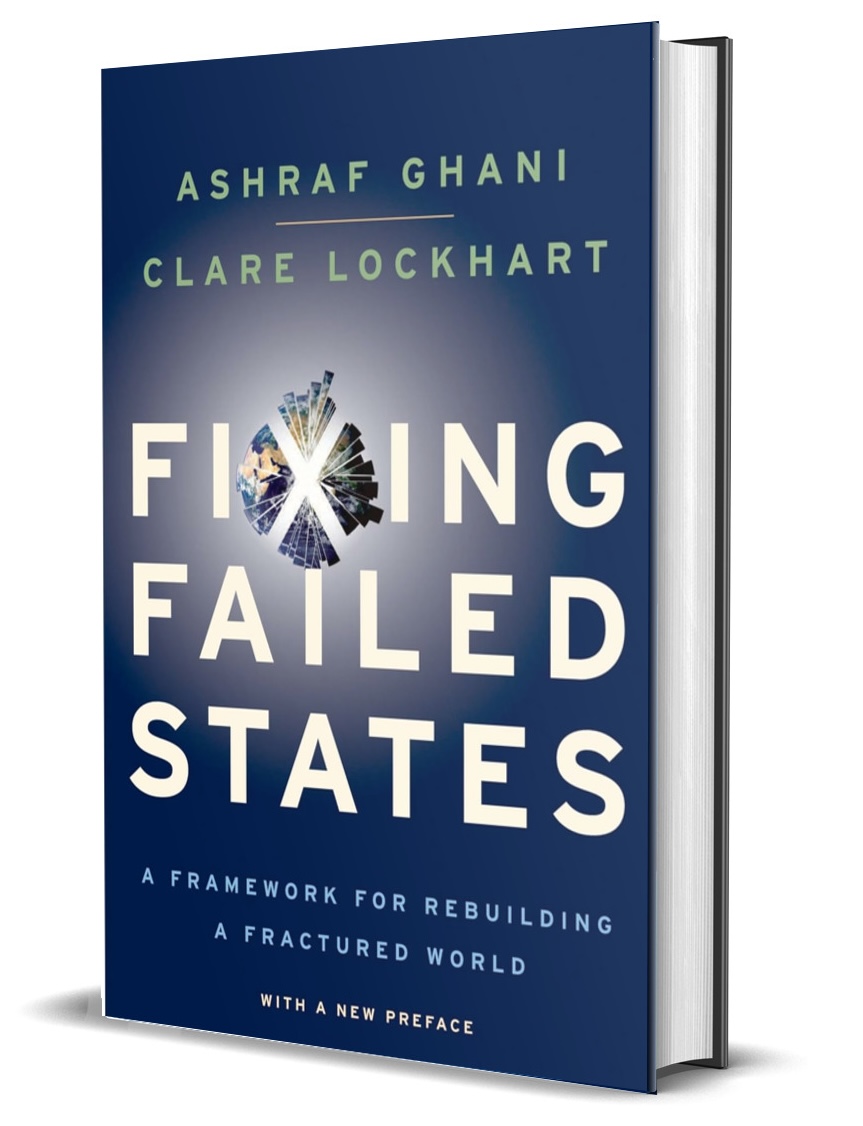
Fixing Failed States: A Framework for Rebuilding a Fractured World by Ashraf Ghani and Clare Lockhart
Summary and takeaways from the book.
Keywords:
Capitalism
Socialism
Jul 17, 2026
This book is about Failed States (failed countries). The authors write about what makes a State. They write about characteristics of what make a failed State. They give suggestions about what can be done to fix the failed States.
"
The ground reality is that many states have collapsed and are unable to provide even the most basic services for their citizens... Forty to sixty states, home to nearly two billion people, are either sliding backward and teetering on the brink of implosion or have already collapsed".
The authors give their own list of 10 functions of a State. States today are bloated and take on tasks which they should not do.
A Libertarian approach to State is a better option. Another alternative is a Singapore like model where benevolent institutions guide progress.
What is a State?
"
In 1918, during the Bavarian revolution, Max Weber articulated his celebrated definition of the state as a human community that “successfully claims a monopoly of the legitimate use of force within a given territory.”"
Force is the basis of a State. When the use of force is seen as legitimate, it is the State. When it is illegitimate, it is terrorism. It is not clear how is legitimacy decided and by who.
Why is it important?
Studying failed States is important as there are 40-60 failed States which are a liability on rest of the World, as well as a security risk.
"
Within these countries, vicious networks of criminality, violence and drugs feed on disenfranchised populations and uncontrolled territory". Networks of criminality, violence and drugs are seldom local. They span the globe. Crime, drugs, and violence is exported internationally.
The other reason why study of failed States is important is that aspirations of billions are unfulfilled because of the failed States.
"
The ground reality is that many states have collapsed and are unable to provide even the most basic services for their citizens... A consensus is now emerging that only sovereign states—by which we mean states that actually perform the functions that make them sovereign—will allow human progress to continue.".
People in failed states can contribute to global prosperity but they cannot.
The whole world loses out. "
Dysfunctional states are the key obstacle to the realization of aspirations of untold millions of people to be active participants in a world that is both prosperous and secure. Instead, they still live in dire poverty because they are unable to connect to this unprecedented stock of global wealth and knowledge".
"
Although terrible poverty exists in most of these countries, to call them “poor countries” is inappropriate in many cases. Many have vast natural resources—oil, natural gas, valuable industrial metals, minerals, and fertile soil. They have the capacity to manufacture goods, grow fruits and vegetables, generate exports, and provide services. But because most citizens are forced to operate outside the legal system (or indeed any system of agreed-upon conventions) due to burdensome, costly, and corrupt bureaucratic procedures, the governments in question are able to tap into the incomes of only a fraction of the potential taxpayers. After massive diversions of funds from mining operations and customs procedures, domestic revenue on the books will appear minimal."
International Organizations have failed
International Organizations are venues for what the author calls 'Rituals of Sovereignty'. The rituals bestow legitimacy and authority to both sovereign States as well as the International Organizations, but don't lead to anything useful.
International Organizations don't achieve much as their consultants and policies are far removed from ground realities.
Singapore as an example of successful State Building
The authors list Singapore, South Korea, Malaysia, Chile, and Dubai as examples of successful State building.
Singapore developed capability/capacity in shipping port management, housing, construction, social contracts (pensions).
"
Investment in human capital has ranged from technical education in industrial training (particularly in higher-end precision engineering and process industries) to specialized financial services. High-achieving students were sent to Oxford, Cambridge, Stanford, and Harvard; top generals received business degrees and were circulated out of the army to run corporations; and investment in talent was in general widespread. After nine years as prime minister, Lee Kuan Yew himself went on sabbatical to the Kennedy School of Government at Harvard to reflect on the next phase of Singapore's development."
Singapore “had to fight every inch of the way to establish confidence in our integrity, competence and judgment. The history of our financial center is the story of how we built up credibility as a place of integrity, and developed the officers with the knowledge and skills to regulate and supervise the banks, security houses, and other financial institutions."
"One might call this [Singapore success story] a blueprint for the creation of the necessary institutions in a failed state, even where the materials for these seem nonexistent."
* * *
"Prosperity is thus within the reach of all of humanity, but to attain this goal we must first address its necessary precondition—effective states that perform the necessary functions for their citizens in our complex world."
"Security will not be guaranteed by the use of force, though military intervention might be called upon from time to time. Security will come through the creation of functioning states."
It is worth repeating for its importance. "
[Global] Security will come through the creation of functioning states".
A functioning State cannot be imposed from top or built by international organizations. Participation of locals is important. It has to be a 'strategic partnership'. "
The Marshall plan's [for reconstruction of Europe after the Second World War] institutional framework made the recipient country the driver of strategy and policy as well as project manager; the United States' role was to act as collaborator and provider of balance of trade support".
Related articles
From Third World to First: The Singapore Story: 1965-2000 by Lee Kuan Yew
Toward a Libertarian Society by Walter Block
External Links